Table of Content
If you have damage to the area from an injury, surgery to repair arteries or tissue could be helpful. If you have stuttering priapism, your doctor may prescribe medical treatments to prevent future events. Priapism develops when blood in the penis becomes trapped and unable to drain.
Since this type of priapism can resolve spontaneously after weeks of healing, physicians will often take a watch-and-wait approach. Surgery might be necessary in some cases to insert material, such as an absorbable gel, that temporarily blocks blood flow to your penis. You might also need surgery to repair arteries or tissue damage resulting from an injury. Blood drawn from your arm can be tested to measure the number of red blood cells and platelets present. Results might show evidence of diseases, such as sickle cell disease, other blood disorders or certain cancers. Your doctor might be able to determine what type of priapism you have based on whether you're experiencing pain and the rigidity of the penis.
Publication types
Stuttering priapism – This type of priapism is similar to low-blood flow priapism except that it is episodic. The re-occurring, painful erections usually last between 2 and 3 hours before returning to a flaccid state. If you have this type of priapism, it may occur during sleep, or before or after sexual stimulation. Over time, the episodes of priapism may become more frequent and last longer. Like low blood flow priapism, this type of priapism can cause permanent damage to the penis and affect your sexual function. It is important to seek medical treatment if this is happening to you.
With nonischemic priapism, the prognosis is often good since the blood supply to the penis is not compromised, just disrupted. If damage has occurred, surgery can repair the ruptures and allow erectile function to return to normal. In cases of ischemic priapism, if it is treated early and successfully, erectile function should return to normal.
What is the outlook for people with priapism?
Excess blood is drained from your penis using a small needle and syringe . As part of this procedure, the penis might also be flushed with a saline solution. This treatment often relieves pain, removes oxygen-poor blood and might stop the erection. Simple ice and pressure on the perineum may help end the erection. Your doctor will review your medical history and perform a physical examination to help determine the cause of priapism.
The AUA categorizes body of evidence strength as Grade A (well-conducted and highly-generalizable RCTs or exceptionally strong observational studies with consistent findings), Grade B , or Grade C . Relevant references retrieved by the literature searches were loaded into Distiller SR, systematic review software . One analyst (Dr. Oristaglio) performed screening at the abstract level.
Health Solutions
In that environment, the region remains oxygenated and blood circulates at a rapid rate, causing some semblance of an erection. "It's a non-painful, partial erection, not sexually stimulated," Broderick said. "Sometimes, it may first manifest itself with a morning erection, but more often than not, there's a history of trauma in the preceding 12 to 24 hours." "It is generally the result of a direct trauma to the penis, such as a straddle injury or an injury like a needle stick that lacerated the artery that caused unregulated blood flow," he explained. Broderick said nonischemic priapism, in contrast, occurs with high flow and is also called arterial priapism. The following protocol is one potential example of aspiration/irrigation with instillation of phenylephrine.

Early involvement of urologists when patients present to the emergency department. Priapism most commonly affects males in their 30s and older, but can begin in childhood for males with sickle cell disease. Medical News Today has strict sourcing guidelines and draws only from peer-reviewed studies, academic research institutions, and medical journals and associations. We link primary sources — including studies, scientific references, and statistics — within each article and also list them in the resources section at the bottom of our articles. You can learn more about how we ensure our content is accurate and current by reading our editorial policy. Diagnosing priapism usually starts with a detailed medical history and physical exam.
Database searches resulted in 1,169 potentially relevant articles. After dual review of abstracts and titles, 248 individual studies were selected for full-text dual review, and 66 studies met inclusion criteria and were included in this review. These included 6 trials and 60 case series, but no cohort studies. A comprehensive search of the literature was performed by Pacific Northwest Evidence-based Practice Center. A research librarian conducted searches in Ovid MEDLINE , the Cochrane Central Register of Controlled Trials , and the Cochrane Database of Systematic Reviews .
The AUA nomenclature system explicitly links statement type to body of evidence strength, level of certainty, magnitude of benefit or risk/burdens, and the Panel’s judgment regarding the balance between benefits and risks/burdens . Strong Recommendations are directive statements that an action should (benefits outweigh risks/burdens) or should not (risks/burdens outweigh benefits) be undertaken because net benefit or net harm is substantial. Moderate Recommendations are directive statements that an action should (benefits outweigh risks/burdens) or should not (risks/burdens outweigh benefits) be undertaken because net benefit or net harm is moderate.
The condition develops by itself and is not related to sexual activity. If it longs more than 4 hours, it is treated immediately in the emergency department as it has the potential to damage the tissues of the penis and can cause permanent erectile dysfunction and infertility. Resolution of acute ischemic priapism is characterized by the penis returning to a flaccid, nonpainful state, with restoration of penile blood flow. However, oftentimes, persistent penile edema, ecchymosis, and partial erections occur and mimic unresolved priapism. This often relates to the duration of priapism and may also signify segmental regions of cavernosal ischemia/necrosis. In patients with hematologic and oncologic disorders such as sickle cell disease or chronic myelogenous leukemia, clinicians should not delay the standard management of acute ischemic priapism for disease specific systemic interventions.
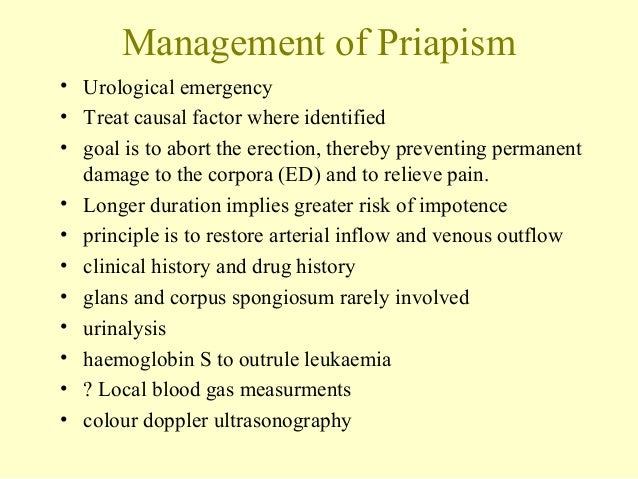
In rare cases, priapism can affect children with sickle cell disease. Ischemic priapism, also called low-flow priapism, is the result of blood not being able to leave the penis. Blood is trapped in the penis because it cannot flow out of the veins of the penis or there is a problem with the contraction of smooth muscles within the erectile tissue of the penis. Ischemic priapism is the more common type of priapism and requires immediate medical care to prevent complications caused by not getting enough oxygen to the penile tissue. Conservative treatment options include exercise, ejaculation, and ice packs.


No comments:
Post a Comment